
Looking for a side-by-side of the programs themselves? That lives on the first-time home buyer loans page, which compares FHA, CalHFA, conventional 3% down, VA and USDA and shows how they stack.
This is the other half of the question: what it actually takes to qualify, what assistance you can realistically get in the Sacramento area, and what the process looks like week by week.
First-time home buyer loan options in Sacramento start well under 20% down, and the eligibility rules are far more flexible than most renters realize. The assumption that you need a spotless credit history and a large cash reserve to buy a home is costing people years of equity building while they wait for a finish line that doesn't actually exist. In 2026, Sacramento-area buyers have access to more loan programs and down payment assistance options than at any point in recent memory, from federal programs that require as little as 3.5% down to California-specific assistance that can cover that down payment entirely.
This guide walks through the core loan types available to first-time buyers in the Sacramento metro, the state and local assistance programs with real numbers attached, eligibility rules that are more flexible than most people expect, what lenders actually look at during underwriting, and the exact sequence of steps from your first conversation to closing day. Working with a Sacramento-local loan officer who knows these programs in detail makes a measurable difference in how this process goes, and that's worth keeping in mind as you read through your options.
First-time home buyer loan options in Sacramento
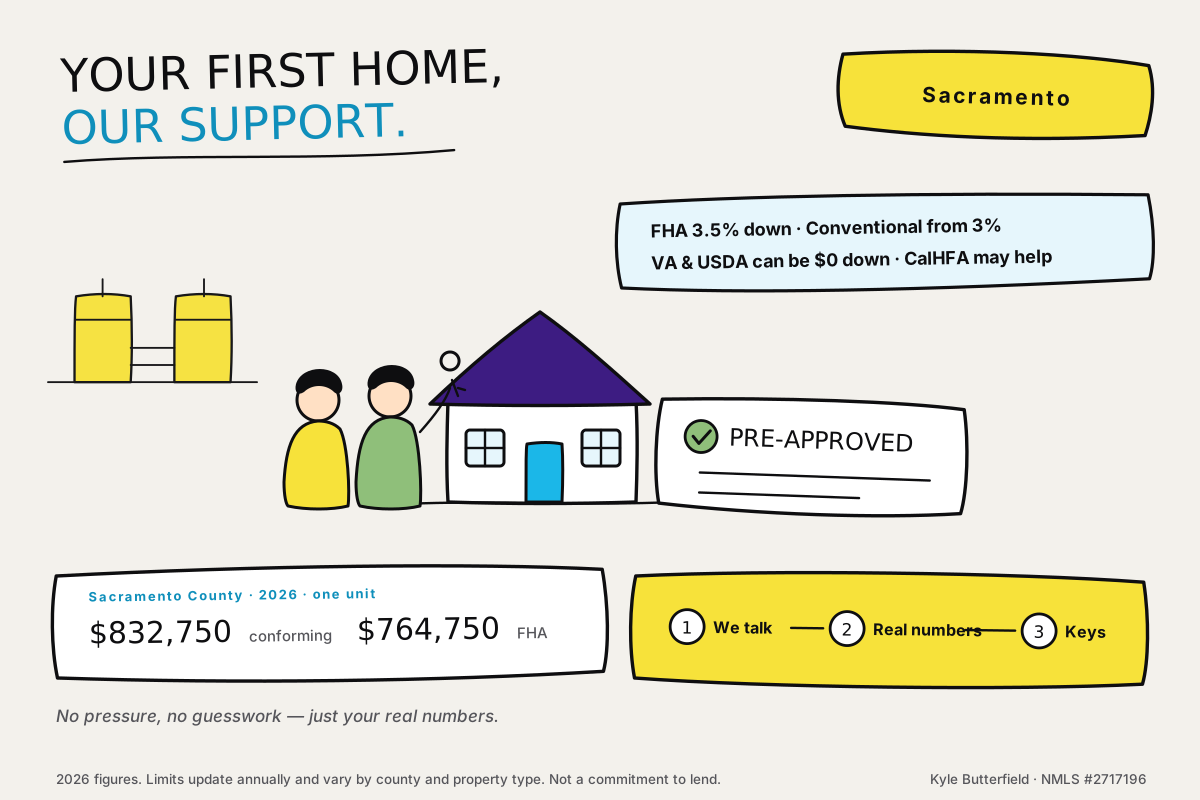
Most first-time buyers in the Sacramento area qualify for at least one of four core loan programs. The right fit depends on your credit score, military status, income, and how much cash you have available. Understanding each option at a basic level before you talk to anyone puts you in a much stronger position.
FHA loans: low down payment for buyers with moderate credit
FHA loans are the most commonly used mortgage for California first-time buyers who don't have a large cash reserve. With a credit score of 580 or above, you qualify for 3.5% down. If your score falls between 500 and 579, you can still use an FHA loan, but you'll need 10% down. FHA loans carry MIP (mortgage insurance premium), which functions similarly to PMI on conventional loans and is added to your monthly payment as part of your total housing cost. When paired with a CalHFA assistance program, an FHA loan becomes one of the most powerful tools available to Sacramento buyers with moderate credit.
VA loans: zero down for eligible veterans and active military
VA loans offer $0 down payment for eligible veterans, active-duty service members, and surviving spouses. The Sacramento area has a significant military population connected to McClellan Park and Beale Air Force Base, and many of those service members don't realize they qualify for this benefit. VA loans carry a funding fee of 2.15% for first-time use with less than 5% down, though buyers with a service-connected disability rating are typically exempt. Even accounting for the funding fee, VA loans are consistently the most cost-effective path for those who are eligible.
Conventional loans: 3% down for stronger credit profiles
Conventional loans through programs like Fannie Mae HomeReady and Freddie Mac Home Possible start at 3% down for buyers with credit scores of 620 or higher. The trade-off compared to FHA: stricter qualifying standards, but lower long-term mortgage insurance costs if your credit profile is strong. For a buyer with a 680 credit score and solid income, a conventional loan paired with CalHFA's MyHome assistance often produces a better monthly payment over time than an FHA loan would.
Sacramento down payment assistance programs in 2026
Sacramento buyers can access assistance from the state of California, from local city and county agencies, and from lender-specific programs. Several of these can be layered together, which is where the real opportunity opens up. Here's what each one actually provides.
CalHFA MyHome and Dream For All: the two flagship state programs
CalHFA MyHome is the workhorse program for most Sacramento first-time buyers. It's a deferred-payment second mortgage, meaning there are no monthly payments on the assistance amount. You repay it only when you sell, refinance, or pay off your first mortgage. The assistance covers up to 3.5% of the purchase price on an FHA loan or up to 3% on a conventional loan. Sacramento County's MyHome income limit changes by program and funding cycle, so check the current figure on CalHFA's official income limits page before counting on eligibility.
Dream For All is a different structure and a bigger opportunity for those who meet the requirements. It provides up to 20% of the purchase price, capped at $150,000, and is designed specifically for first-generation first-time buyers. The 2026 application window opened February 24 using a lottery-style selection process. The income cap is stricter at $191,000, and you must meet the first-generation buyer definition. When you sell the home, you repay the original loan amount plus CalHFA's share of any appreciation. If the home didn't appreciate, there's no appreciation share owed. It's a meaningful program for buyers who qualify, but it's not available to everyone.
Local Sacramento assistance: SHRA, CalHome, and additional options
SHRA (Sacramento Housing and Redevelopment Agency) administers local first-time buyer programs that can provide deferred loans, with amounts set by the specific program and funding cycle. These programs are income-restricted and location-specific within the city or county, and funding availability changes. Before counting on SHRA funds, verify current availability and terms directly with SHRA or through an approved lender, since funding cycles and amounts vary.
The CalHome Program is another statewide option that provides down payment assistance loans to low-income homebuyer assistance Sacramento recipients through participating local agencies. CalHome loans are typically deferred and can be paired with a first mortgage to reduce out-of-pocket costs at closing. Two additional options worth knowing about: GSFA Platinum, which provides up to 5% in assistance and can be paired with FHA, VA, or conventional loans, and the FHLB WISH Program, which offers matching grants through participating credit unions and lenders, with the match ratio and maximum set each year. These programs extend your options when CalHFA funds are in high demand or your situation doesn't fit state program criteria exactly.
Eligibility rules and income limits that actually apply in Sacramento
A significant number of buyers self-disqualify before they've confirmed they actually don't qualify. The eligibility rules are more flexible than most people assume, and understanding them accurately saves you from walking away from opportunities that were available to you all along.
The first-time buyer definition (it's not what most people think)
You do not have to have never owned a home. Under most CalHFA and federal program definitions, you qualify as a first-time buyer if you haven't owned a principal residence in the past three years. This surprises a lot of Sacramento renters who owned a home earlier in their lives and have been assuming ever since that they're locked out of these programs. If you owned a home six years ago, sold it, and have been renting since, you're likely eligible. Check before you assume.
Income limits, purchase price caps, and property requirements
For CalHFA MyHome, Sacramento County has a published income limit that is updated periodically; verify the current figure with CalHFA before relying on it. Dream For All applies a separate, lower income cap along with the first-generation buyer requirement. SHRA programs have lower income restrictions and are designed for low-to-moderate income buyers, so those programs serve a different segment of the market.
On the property side, most programs apply to single-family, one-unit primary residences and approved condominiums. CalHFA does not set a separate purchase price cap, but the first mortgage loan limits still apply. Non-occupant co-borrowers are not permitted under most CalHFA programs, which matters if you were considering using a co-signer who won't live in the home.
What lenders actually look at before approving you
Pre-approval conversations go smoother when you understand what's being evaluated. Lenders aren't looking for perfection, they're looking for a complete picture they can work with. That means your credit score, your income consistency, your debt load, and your asset reserves all factor in together rather than any single number making or breaking your application.
Credit score thresholds and debt-to-income ratio basics
The minimum credit score for a standard FHA loan is 580. CalHFA's own FHA programs sometimes require a 640 or higher, so if you're using state assistance, that number matters. Conventional loans generally require 620 or above. Your DTI (debt-to-income ratio) is the other major factor: it's your total monthly debt payments divided by your gross monthly income. Every program caps DTI, but the ceiling is not one fixed number. It shifts with the program, your income and credit profile, and the investor behind the loan, so the practical limit on your file is something to confirm rather than assume.
The documents you need to gather right now
Most lenders request the following when you apply:
- Two years of federal tax returns
- W-2s from the past two years
- Pay stubs from the last 30 days
- Two to three months of bank statements
- Proof of employment
- Homebuyer education certificate (required for CalHFA programs)
Having these ready before your first lender conversation speeds up the pre-approval process significantly. It also puts you in a stronger position the moment you find the right home, since sellers take offers backed by complete pre-approvals more seriously.
The step-by-step process from first conversation to closing day
The mortgage process feels complicated mostly because nobody lays it out in plain terms. Here's the actual sequence, from start to close.
Steps 1 through 3: pre-approval, program selection, and making an offer
Step 1 is a pre-approval conversation with a CalHFA-approved loan officer who can match your specific numbers to the programs you qualify for. This is where most buyers discover they're closer to buying than they thought. Step 2 is selecting your loan structure. For most Sacramento buyers using CalHFA, this means pairing an FHA first mortgage with MyHome assistance to cover the down payment. Step 3 is using your pre-approval letter to make a competitive offer on a Sacramento-area home. Before any credit authorization, Kyle will tell you whether the step involves a soft or a hard inquiry, so you know what you are agreeing to.
Steps 4 through 6: underwriting, assistance layering, and closing
Step 4 begins once your offer is accepted: you submit your full loan application and documentation package. Step 5 is underwriting, where the lender verifies your income, credit, and assets, and the down payment assistance is formally structured into the loan. Step 6 is closing: you review the final loan documents, sign, and get your keys. Timelines vary with the lender, the investor, and how fast conditions clear, so treat any published range as a guide rather than a promise. That window feels fast when you're not prepared, and completely manageable when you've done the pre-approval work upfront.
How to figure out which program actually fits your situation
The number of programs listed above can feel like a lot to sort through. The good news is that most buyers fit a fairly clear profile once someone runs the actual numbers with them.
Matching your profile to the right loan type
A simple decision framework: if you're a veteran or active-duty service member, start with VA. No down payment, no monthly mortgage insurance, and the funding fee is often lower than the insurance cost on other loan types. If your credit score is between 580 and 619, FHA is your most likely path and MyHome can cover the down payment. If your credit is 620 or above and you have some savings, a conventional loan paired with MyHome may produce a better long-term payment. If you're a first-generation buyer with household income under $191,000, pursue Dream For All if the application window is open. Your loan officer can tell you which window to watch for.
Starting with a free, no-pressure pre-approval consultation
Kyle Butterfield (NMLS #2717196) is a Sacramento-local mortgage loan officer who works specifically with first-time buyers in Roseville, Rocklin, Folsom, and Sacramento proper. His process starts with your actual numbers, not a sales pitch. The first conversation carries no commitment, and before any credit authorization he will explain whether the next step uses a soft or a hard inquiry. The goal is simply to show you what you qualify for so you can make an informed decision, and that grounded, straightforward approach is exactly what a decision this significant deserves.
The barrier is lower than you think
The biggest takeaway from this guide is straightforward: the barrier to buying a first home in Sacramento in 2026 is almost always lower than buyers expect. Between FHA loans at 3.5% down, VA loans at zero down, CalHFA MyHome covering that down payment with no monthly payment required, Dream For All for first-generation buyers, and local SHRA programs adding additional assistance, the combination of options available right now is substantial.
Most Sacramento renters who assume they're not ready simply haven't confirmed that with someone who knows the actual numbers. The three-year lookback window means prior homeowners often qualify. Income limits reach well into six figures. And programs like CalHome specifically exist to support low-income homebuyers in Sacramento who need the most help getting across the threshold. The next step for any first-time home buyer exploring Sacramento loan options isn't signing anything. It's a single conversation to find out where you actually stand. That conversation costs nothing, and the information you get from it is the foundation everything else is built on.