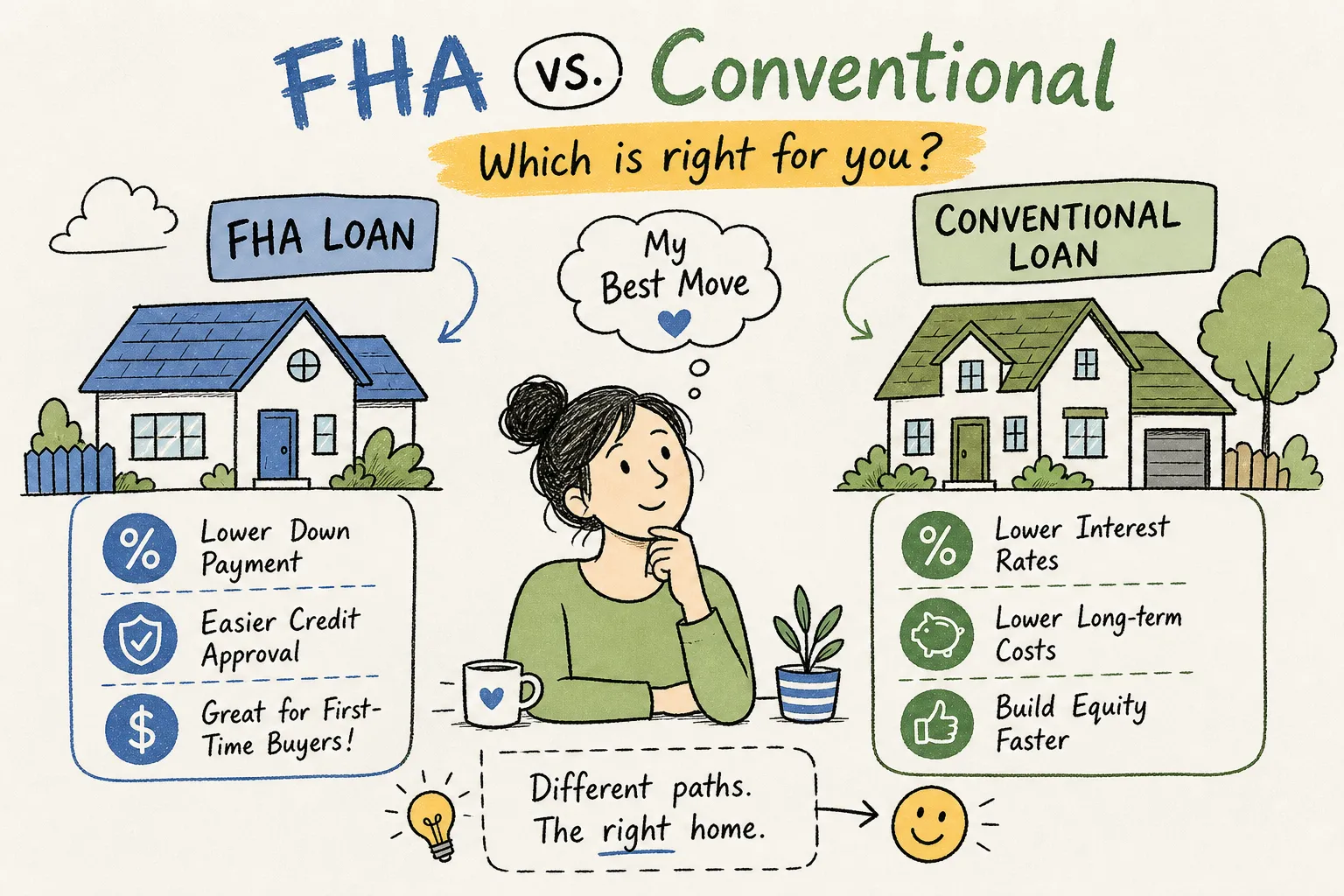
Deciding between an FHA vs. conventional loan is one of the most common sources of confusion for home buyers in 2026, and for good reason. Someone in your life told you to go FHA. Someone else said conventional. Neither one explained the difference beyond "FHA is easier to get," and now you're stuck trying to figure out which piece of advice to follow. Both loan types are frequently recommended but rarely explained in a way that actually helps you make the call.
The honest answer is that neither loan is universally better. The right choice depends on three things: your credit score, how much you've saved for a down payment, and how long you plan to stay in the home. Get those three variables on the table and the decision usually becomes obvious. Sacramento mortgage loan officer Kyle Butterfield walks first-time buyers through this exact FHA vs. conventional loan comparison regularly. By the end of this breakdown, you'll have a clear framework to figure out where you land. No pressure toward a quick decision required.
FHA vs. conventional loan: qualifying differences
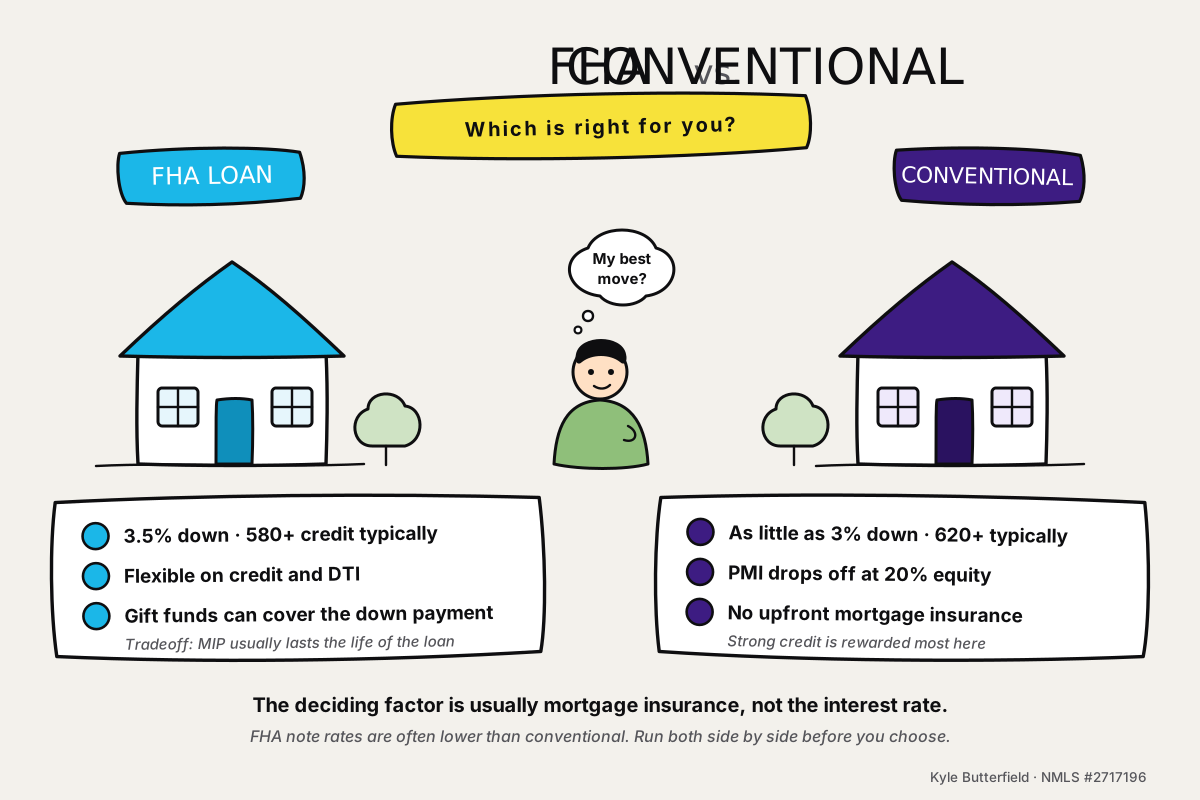
FHA is a government-backed loan program designed to lower the barrier to homeownership. Conventional loans are privately backed and reward borrowers with stronger credit and larger down payments. That fundamental difference shapes every other comparison between them.
Minimum credit score requirements
FHA accepts a 580 credit score for 3.5% down. Borrowers with scores between 500 and 579 can still qualify, but they'll need to bring 10% down instead. Conventional lenders typically set their floor around 620, and borrowers above 700 tend to access the most competitive rate tiers, a pattern consistent with standard lender pricing grids. In practical terms, a buyer who's been rebuilding credit after a difficult stretch may not yet qualify for conventional but can still access FHA financing and start building equity now.
Down payment minimums in 2026
FHA requires 3.5% down at a 580 or higher credit score. On a $400,000 home, that's roughly $14,000. Conventional loans can go as low as 3% for qualifying first-time buyers through specific programs, though 5% is more common in practice. Both loan types allow lower down payments, but each comes with trade-offs covered in the next section.
DTI limits and flexibility
Both programs cap debt-to-income, and FHA is generally the more forgiving of the two when compensating factors are present, such as significant reserves or a long employment history. The exact ceiling is not a fixed number: it moves with the program, your credit and income profile, and the investor buying the loan. A buyer with a tighter DTI and a moderate credit score is more likely to get approved through FHA than conventional, which is why some buyers who meet conventional's technical minimums on paper end up better served by the FHA route.
FHA vs. conventional loan, mortgage insurance and long-term costs
This is the most misunderstood part of the comparison. Many borrowers know that both loan types require mortgage insurance below 20% down, but few understand how different the costs and durations actually are.
How FHA mortgage insurance works
FHA charges two layers of insurance. First, there's an upfront mortgage insurance premium (UFMIP) of 1.75% of the loan amount at closing, which can be rolled into the loan balance. On a $400,000 loan, that adds $7,000 to your debt on day one. Second, there is an annual MIP paid monthly, priced off your loan amount, term and loan-to-value under HUD's published schedule. The larger concern: if your down payment is under 10%, FHA MIP lasts for the entire life of the loan. You keep paying it even after building substantial equity, which changes the long-term math significantly.
How conventional PMI compares
With the most common conventional PMI structure, standard monthly PMI, there is no upfront premium equivalent to FHA's UFMIP. (Single-premium and lender-paid PMI options exist but are less common.) The monthly cost is priced off your credit score and loan-to-value, and the spread between the best and worst tiers is wide enough to change the comparison on its own. The critical advantage over FHA: PMI cancels automatically when you reach 22% equity and can be requested off at 20%. FHA MIP, by contrast, generally doesn't stop unless you refinance into a conventional loan.
Interest rates and loan limits in 2026
FHA and conventional rates both move with the broader market, but they don't move identically. In 2026, one loan type has been consistently coming in lower on rate, and it matters for your monthly payment.
2026 rate comparison: FHA vs. conventional
FHA note rates often come in below comparable conventional conforming rates, particularly at lower credit tiers. How wide that gap runs changes with the market, your credit profile, and the lender, so any specific spread you see published is a snapshot rather than a quote. As a sense of scale, a difference of about a quarter point on a $400,000 loan works out to roughly $60 to $80 a month. That gap sounds compelling, but it can be offset by FHA's lifetime MIP, which is exactly why the interest rate alone doesn't settle the FHA vs. conventional loan comparison. You need to look at total cost across your expected ownership period.
Loan limits and what they mean for Sacramento buyers
In 2026, the FHA loan limit for Sacramento County, Placer County, and El Dorado County sits at $764,750 for a single-unit home, which is above the national FHA floor of $541,287. The baseline conforming limit is $832,750 for a one-unit home, and designated high-cost counties are higher. For buyers targeting higher-priced properties in Folsom, Roseville, or parts of the Sacramento metro, the higher conventional limit provides significantly more purchasing power. Buyers shopping above the FHA county limit will need conventional financing or a jumbo loan product.
Which type of buyer benefits most from each loan
When FHA makes more sense
FHA is the stronger fit for buyers with credit scores in the 580 to 649 range, buyers who can only put 3.5% down with limited cash reserves, and buyers whose DTI is tighter than most conventional lenders will accept. It also works well when a lower interest rate is what makes a given purchase price manageable. If you plan to stay in the home long-term, the lifetime MIP is a real cost to factor in, but the lower entry barrier often makes FHA the right starting point for buyers who would otherwise keep renting while waiting for a perfect financial profile that may take years to reach.
When conventional is the better choice
Conventional is the stronger fit for buyers with a 680 or higher credit score, a down payment of 10% or more, and a manageable DTI, though these thresholds serve as general guidance rather than hard rules, and lender overlays vary. The absence of an upfront premium and the ability to cancel PMI typically makes conventional less expensive over a seven to ten year horizon. For Sacramento-area buyers shopping above the FHA loan limit, conventional is often the only conforming path that doesn't require a jumbo product, which carries its own qualification requirements.
The total cost picture: upfront vs. long-term expenses
Monthly payment comparisons are a starting point, not a complete answer. The smarter analysis includes full costs across your first decade of ownership.
Upfront costs: FHA is more expensive at closing
The FHA UFMIP adds 1.75% to your loan balance at closing. Even when it's financed into the loan rather than paid out of pocket, it increases your total debt and your monthly payment from the start. On a $400,000 purchase, financing the FHA UFMIP adds $7,000 to your loan balance on day one. Conventional buyers skip that cost entirely, which gives them a cleaner starting position.
Long-term costs: the MIP vs. PMI breakeven
Over ten years, a conventional borrower who reaches 20% equity can request PMI cancellation and eliminate that monthly cost permanently. An FHA borrower with less than 10% down keeps paying MIP for the life of the loan unless they refinance into conventional, which carries closing costs of its own and takes time to recover them. For a typical Sacramento purchase, conventional tends to pull ahead on total cost somewhere in the second half of the first decade, once PMI cancels. Exactly where that crossover lands depends on your rate, your down payment, how fast equity builds, and the investor pricing behind each option. FHA buyers can reach the same outcome through a refinance, but it requires an additional step and additional costs to get there.
How to decide without just guessing
A two-question shortcut to narrow your options
Two questions filter most buyers quickly. First: what is your credit score? Second: how much do you have saved for a down payment? These cutoffs are general rules of thumb, and lender guidelines vary, but as a starting framework: if your score is below 640 and your savings are below 10% of the purchase price, FHA is almost certainly the better starting point. If your score is above 670 and you have 5% or more saved, conventional deserves a close look. From there, the MIP versus PMI math and your expected time in the home close the gap and point you toward a clear answer.
Working through the real numbers with someone who won't rush you
The decision sharpens considerably when someone runs both loan scenarios side by side with your actual numbers rather than hypothetical ones. Kyle Butterfield is a Sacramento-based mortgage loan officer who specializes in walking first-time buyers through exactly this comparison, including FHA, conventional, and CalHFA down payment assistance options, without pushing anyone toward a quick decision. His pre-approval consultations are designed to give you a complete picture before you commit to anything, and he will tell you up front whether the next step involves a soft or a hard credit inquiry. For buyers in Roseville, Folsom, Rocklin, or anywhere in the greater Sacramento metro, that kind of patient, numbers-first walkthrough is often the difference between choosing the right loan and choosing the most familiar one.
When choosing between an FHA vs. conventional loan, weigh your credit score, down payment, DTI, and expected time in the home, not what a friend recommended or an ad pushed. FHA opens the door for buyers with moderate credit and limited savings. Conventional rewards stronger financial profiles with lower long-term costs and no lifetime mortgage insurance. Run both scenarios before you decide. If you'd rather have someone walk you through the real numbers based on your actual situation, reach out to Kyle Butterfield directly for a no-pressure consultation and get a clear answer before you commit to anything.
Still weighing the two? Work through the step-by-step decision guide for the three questions that narrow it fastest, and how the costs diverge by year five.