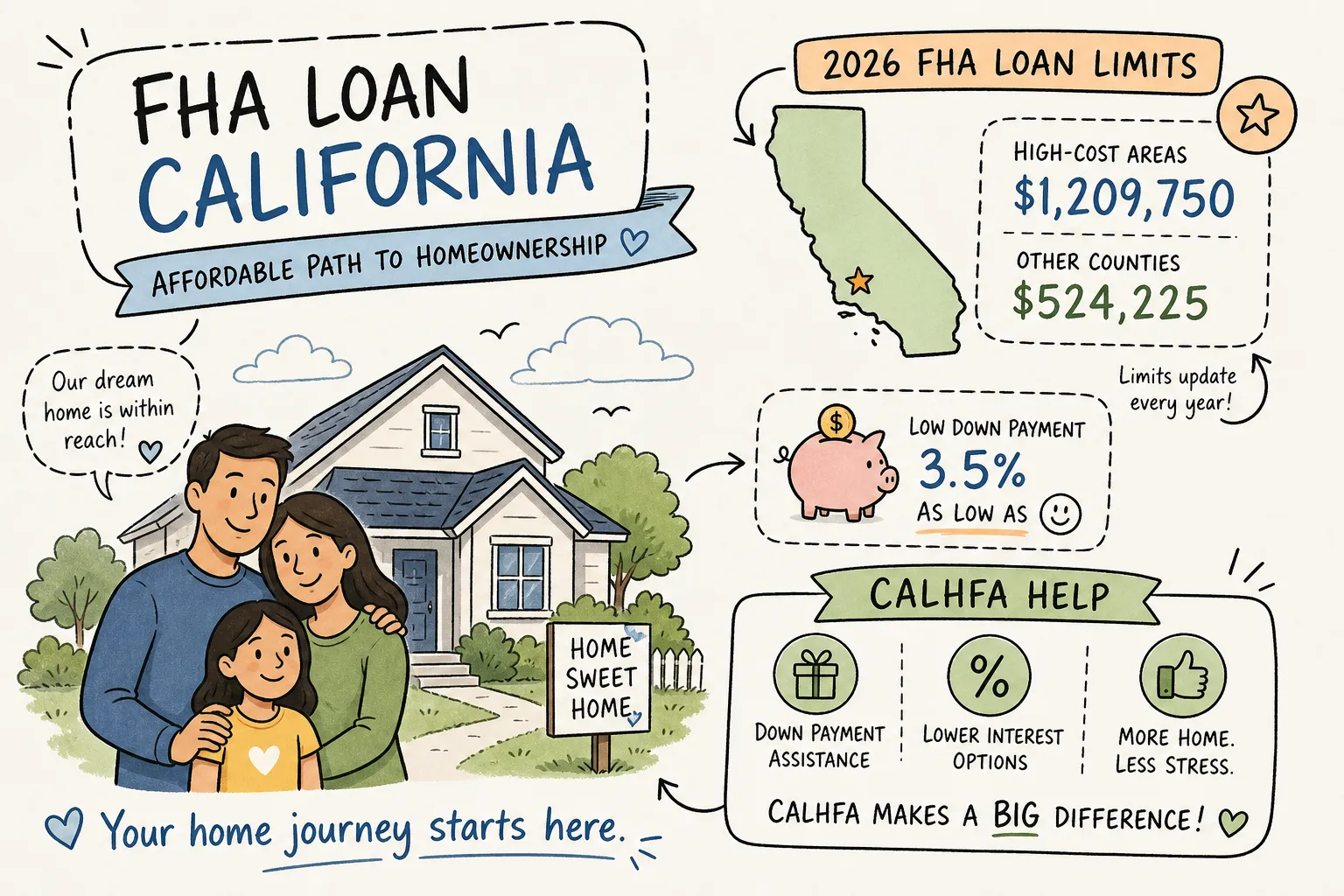
An FHA loan in California can make homeownership more accessible than most buyers realize, but understanding the specifics matters. First-time buyers in the Sacramento metro often fall into one of two traps: assuming an FHA loan is their only realistic option, or assuming they don't qualify for anything at all. Both assumptions are usually wrong, and both are fixable with the right information.
The federal rules and what Sacramento-area lenders actually require are not always the same thing. County loan limits vary significantly across California's 58 counties. Mortgage insurance costs follow a published FHA MIP schedule, predictable once you understand how loan size and LTV interact. And CalHFA's down payment assistance programs can eliminate the 3.5% down requirement entirely for eligible buyers.
This guide gives you the real numbers for 2026: qualifying thresholds, county-specific FHA loan limits for Sacramento, Placer, and El Dorado counties, mortgage insurance costs, CalHFA assistance details, and the document checklist you need before you talk to a lender. Read through once and you'll know whether an FHA loan in California is your path, or whether a different loan type serves you better.
FHA loan California requirements: credit, DTI, and down payment
The credit score tiers and why lender overlays matter
FHA's federal rules set the floor at a 580 credit score for a 3.5% down payment. Borrowers with scores between 500 and 579 can still access FHA financing, but they're required to put 10% down. Scores below 500 are not eligible for standard FHA purchase loans.
Here's what most buyers don't know: California lenders frequently apply their own overlays that push the effective minimum higher than FHA's federal baseline. Many lenders in the Sacramento area require a 620 or 640 minimum score even though FHA itself would approve lower. If you plan to layer CalHFA assistance on top of an FHA loan, the minimum is a firm 640, that's CalHFA's published requirement for government loan programs, though some program variants or lender overlays may require higher scores. While the federal floor is 580, your real-world working minimum in California is often 620 to 640 depending on the lender and whether you want assistance.
How DTI limits work and where California buyers run into trouble
Debt-to-income ratio (DTI) is your total monthly debt payments divided by your gross monthly income. There is a ceiling, but there is no single number that applies to everyone. Automated underwriting weighs the whole file, so compensating factors like strong cash reserves, a longer employment history, or a larger down payment can stretch what is allowed. The threshold that applies to you depends on the program, your income and credit profile, and the investor behind the loan, which is why I check it against your actual file rather than a published maximum.
California buyers hit a specific pressure point here: higher purchase prices produce larger loan amounts, which means larger monthly payments and tighter DTI headroom. Whatever ceiling applies to your file, principal, interest, taxes and insurance all count against it, and existing car payments and student loans can close the window faster than buyers expect. Running your own numbers in advance prevents surprises.
Down payment rules and acceptable sources
The FHA down payment is 3.5% of the purchase price for buyers with 580+ credit, and 10% for the 500, 579 tier. On a $500,000 Sacramento home, 3.5% equals $17,500. Funds can come from personal savings, a verifiable gift from a family member, or an approved assistance program, but gift funds require a signed gift letter and documentation showing the money is not a loan. CalHFA's MyHome Assistance is one of the approved ways to cover that 3.5% entirely, which means some eligible buyers enter homeownership with no money out of pocket for the down payment itself.
2026 FHA loan limits for Sacramento, Placer, and El Dorado counties
Why California counties get higher FHA limits than most of the country
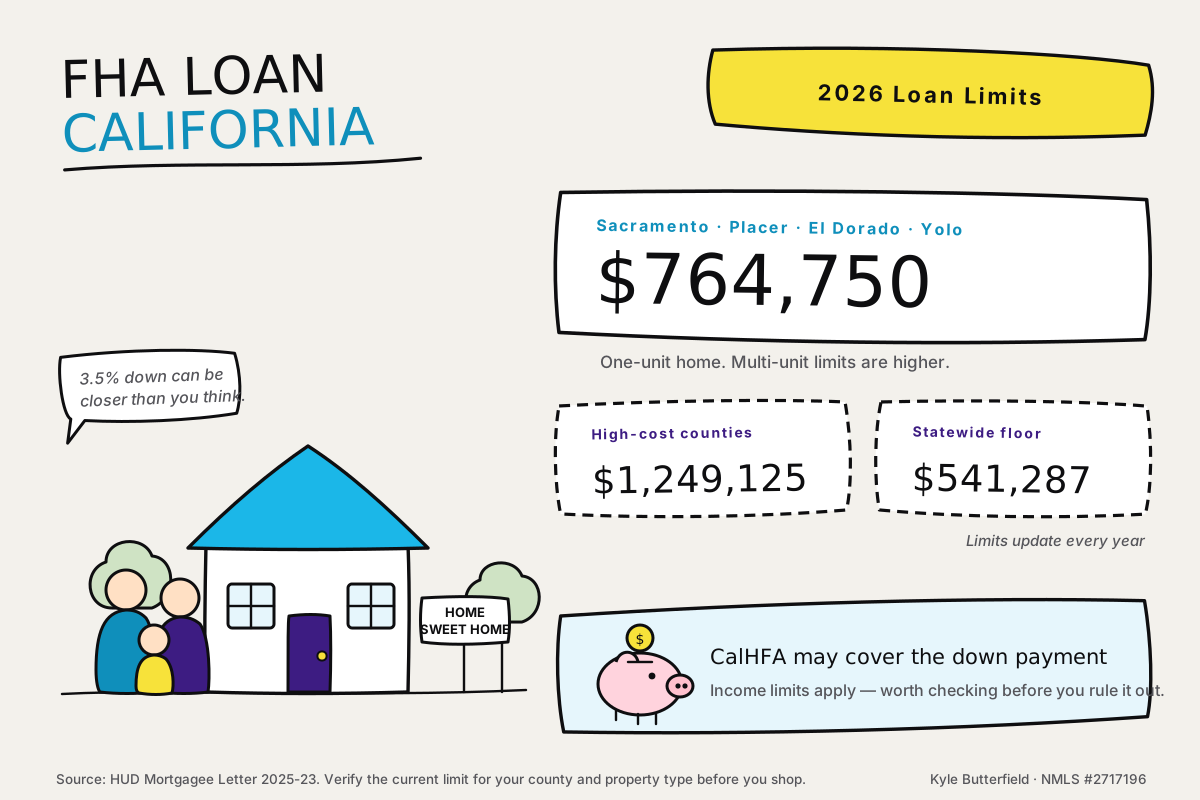
HUD calculates FHA loan limits county by county using local median home prices. The national FHA floor for 2026 is $541,287, and that's what most inland and rural counties across the country receive. California's coastal and metro counties get significantly higher limits because local home prices justify them. For Sacramento-area buyers, the limits in your market are calibrated to actual local prices, not a national average that doesn't reflect what homes cost here.
FHA loan California limits: Sacramento, Placer, and El Dorado (2026)
All three counties in the Sacramento metro core share the same 2026 FHA limit for a single-family home: $764,750. Per HUD's 2026 county loan limit data, Sacramento County, Placer County, and El Dorado County are all set at that figure, meaning buyers in Roseville, Rocklin, Folsom, and Sacramento proper are all working with the same ceiling. That's more than $223,000 above the national FHA floor, which reflects how significantly the Sacramento market sits above what most of the country experiences.
To put that in practical terms: if you're targeting a home near the Sacramento metro median price, you're well under the $764,750 ceiling and fully within FHA financing territory. Buyers shopping in the upper range of Placer County neighborhoods should note where that ceiling falls relative to their target purchase price, because once you exceed it, your options shift.
What happens when a home's price pushes past the county FHA limit
If the purchase price exceeds $764,750 in these counties, you can't finance the entire amount through an FHA loan. You'd need to cover the difference as additional down payment, or pivot to a conventional or jumbo loan. This situation comes up less frequently in Sacramento County than in coastal markets like San Francisco, where the FHA ceiling reaches $1,249,125. Buyers targeting higher-end properties in Placer County's newer communities should run the math before assuming an FHA loan in California works for their specific target home.
What FHA mortgage insurance actually costs you in California
Upfront MIP: the cost built into your loan at closing
FHA charges 1.75% of the base loan amount as an upfront mortgage insurance premium (UFMIP) at closing, a rate confirmed in current HUD MIP guidance. On a $500,000 purchase with 3.5% down, your base loan amount is $482,500. At 1.75%, that's $8,444 in upfront MIP. Most buyers roll this into the loan rather than paying it out of pocket, which slightly increases the loan balance and the resulting monthly payment, but avoids a large cash outlay at closing when you're already managing other costs.
Annual MIP rates in 2026 and how loan size affects them
Annual MIP on a 30-year FHA loan runs between 0.50% and 0.75% depending on your loan amount and LTV, per FHA's published MIP schedule. For standard-balance loans with the 3.5% minimum down payment, the annual MIP rate is 0.55%. For higher-balance FHA loans, meaning those above the standard limit for the county, the structure changes:
- LTV at or below 95%: annual MIP of 0.70%
- LTV above 95%: annual MIP of 0.75%
This matters for Sacramento buyers in the mid-to-upper price range: once your loan amount crosses into higher-balance territory, you are paying a meaningfully higher annual MIP cost every month compared to a buyer whose loan stays below that threshold. Confirm the current thresholds before you rely on them, since they move with the annual limits.
How long you pay annual MIP on a 30-year FHA loan
With less than 10% down on a 30-year FHA loan, annual MIP lasts for the life of the loan. It does not automatically cancel when you reach 80% LTV the way private mortgage insurance does on a conventional loan. This is one of the most important trade-offs to understand: FHA's lower entry barrier, easier credit and down payment requirements, comes with a permanent monthly insurance cost unless you eventually refinance into a conventional loan after building equity. Buyers with 700+ credit and 5% or more saved should specifically compare FHA's lifetime MIP against conventional PMI, which disappears at 80% LTV.
CalHFA FHA: layering down payment assistance onto your mortgage
What the CalHFA FHA first lien actually is
CalHFA's FHA program is not a separate loan type. It's a first-lien FHA mortgage offered through CalHFA-approved lenders, with CalHFA's income limits and program terms layered on top. The property must be your primary residence, non-occupant co-borrowers are not allowed, and you must work with a CalHFA-approved lender. The minimum credit score for CalHFA's government loan programs is 640. CalHFA does not impose its own purchase price ceiling; the FHA county loan limit is the cap that applies.
MyHome Assistance: covering the 3.5% FHA down payment
MyHome Assistance provides up to 3.5% of the purchase price as subordinate assistance for FHA loans, enough to cover the entire required FHA down payment. It's structured as a deferred-payment subordinate loan, not a grant: you'll repay it when you sell or refinance the home. On a $500,000 Sacramento purchase, MyHome could provide $17,500 toward your down payment, meaning a buyer who meets the income and eligibility requirements could purchase that home without bringing a down payment to closing at all.
Income limits, eligibility rules, and homebuyer education
CalHFA uses county-based income limits to determine eligibility, and they differ by program and by county. Rather than quote a figure that moves, check the current number for Sacramento County against CalHFA's official income limits page before you count on eligibility. I verify the applicable limit for your program and household before recommending assistance. Homebuyer education is required for first-time buyers using CalHFA assistance. CalHFA also offers Dream For All, a shared-appreciation program for first-generation buyers that can provide up to $150,000 toward a purchase, but it operates under additional rules and functions differently from MyHome. It's worth discussing separately with your loan officer to understand whether it fits your situation.
Documents you need and a realistic California FHA timeline
Pre-approval checklist: what to gather before you talk to a lender
The documents that move a California FHA pre-approval forward are consistent across lenders. You'll need two years of federal tax returns, W-2s or 1099s for those same years, recent pay stubs covering the last 30 days, two months of bank statements for all accounts you're using for reserves or down payment, and a government-issued photo ID. If you're using gift funds or down payment assistance, documentation showing the source and transfer of those funds is also required upfront.
Buyers with complex income situations, including self-employment, significant commission income, or multiple jobs, should expect to provide additional documentation and raise these details in the first conversation with their lender. The more clearly your income is documented before underwriting, the fewer delays you'll encounter later. Gathering these documents before your first lender conversation signals seriousness and speeds the process considerably.
From pre-approval to closing: a realistic California FHA timeline
Timelines vary with the lender, the investor, and how quickly conditions get cleared, so treat any published range as a rough guide rather than a promise. The process moves through four stages: pre-approval review, full loan application, underwriting and appraisal, then final approval and closing. The stage that most often creates unexpected delays is the FHA appraisal. FHA-approved appraisers evaluate not just value but also whether the property meets FHA minimum property standards, and older California homes frequently require repairs before closing.
Common repair flags include peeling paint in pre-1978 homes, roof condition issues, exposed electrical wiring, plumbing leaks, and structural concerns. None of these necessarily kill a deal, but they add time. Buyers targeting older Sacramento neighborhoods or dated rural properties should budget extra time in their purchase timeline and discuss property condition with their agent before making an offer on a home likely to surface repair requirements.
How to determine whether an FHA loan in California is the right fit
When an FHA loan makes the most sense
FHA financing tends to be the strongest option for buyers with credit scores in the 580, 680 range, where conventional loan pricing becomes less favorable. It's also the right conversation to have when savings are limited: the 3.5% down requirement, especially when combined with CalHFA's MyHome Assistance, makes ownership achievable before a buyer has accumulated a large down payment. Buyers in Sacramento, Roseville, Rocklin, or Folsom targeting mid-range homes well within the $764,750 county ceiling often find that a California FHA loan provides the predictability and lower entry point they need.
When it's worth comparing FHA to a conventional loan instead
Buyers with credit scores above 700 and 5% or more saved should run a side-by-side comparison before choosing FHA by default. The lifetime MIP on a 30-year FHA loan adds up significantly over time, and a conventional loan with PMI that drops off at 80% LTV can produce lower total costs over a 7- to 10-year ownership period. The clearest way to make this decision is with an actual monthly payment comparison using your specific numbers, not a general rule about which loan type is "better."
Running your own numbers with a Sacramento loan officer
Every threshold in this guide, credit tiers, DTI limits, county loan limits, and CalHFA income limits, applies differently depending on your actual income, existing debts, and the purchase price you're targeting. Combined with what you know about your specific situation, that's the only way to get a real answer about what you qualify for.
Kyle Butterfield (NMLS #2717196) works with Sacramento-area buyers through exactly this kind of review: a single conversation that maps your real qualifying numbers across FHA, conventional, and CalHFA options, with no sales pressure and a clear heads-up before any credit authorization about whether the step involves a soft or hard inquiry. The goal is simply clarity, does an FHA loan in California fit your situation, or does a different path serve you better? That answer should come from your actual numbers, not from an assumption you've been carrying for years.
The bottom line on FHA loans in California for 2026
FHA loans in California are more accessible than most buyers assume, and the 2026 limits in the Sacramento metro are specifically calibrated to reflect what homes actually cost here. A $764,750 ceiling in Sacramento, Placer, and El Dorado counties covers the vast majority of purchases in this market. The credit, DTI, and down payment requirements are real thresholds with real flexibility built in, especially when CalHFA's MyHome Assistance is in the picture.
The most common mistake buyers make is sitting on the sidelines because they've made assumptions rather than run the actual numbers. Credit overlays, MIP costs, income limits, and county ceilings all sound complicated until someone walks you through them with your specific information in hand. At that point, the decision usually becomes straightforward.
If you're buying in the Sacramento area and want to know exactly where you stand on an FHA loan in California, reach out to Kyle Butterfield for a qualifying review, an honest look at what you qualify for and which loan program actually fits your situation. Before any credit authorization I will tell you whether the next step uses a soft or a hard inquiry.
For the underlying eligibility rules rather than the 2026 numbers, see FHA loan requirements in California.