If you have already read how FHA and conventional loans compare and still cannot tell which one is yours, this guide is the next step. It is not another side-by-side list. It is the decision path I actually walk Sacramento buyers through, in the order the questions matter.
Both programs let you buy with well under 20% down, and that surface similarity is why buyers stall for weeks. The choice is rarely settled by the interest rate. It is usually settled by how mortgage insurance behaves on each loan, and that difference compounds for as long as you hold the mortgage.
Start here: three questions that narrow it fast
Most buyers can rule out one program in about five minutes. Answer these three before you request a single rate quote.
Question 1: Where does your credit score sit?
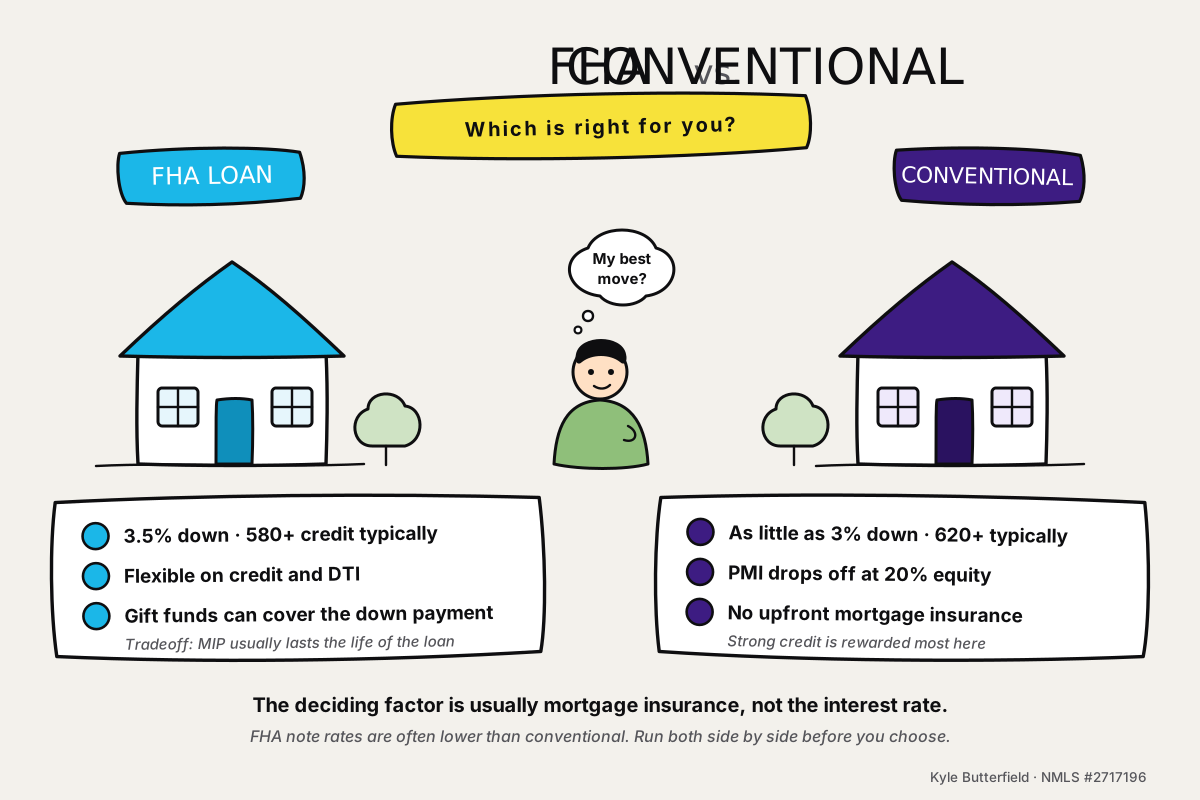
FHA works on a two-tier structure. At 580 or above you can put 3.5% down. Between 500 and 579 the minimum jumps to 10%. Below 500, FHA is not available.
Conventional can start at 3% down, but lenders generally want 620 or better, and that number is only the door. How far above 620 you sit drives both your rate and your PMI cost. A 621 and a 740 both qualify, and they are priced very differently.
Below 620: FHA is realistically your path. 620 to 679: both are open. This band needs real numbers, not rules of thumb. 700 and above: conventional usually wins on total cost.
Question 2: How much cash do you have after closing?
Not before. After. Closing costs, inspection, appraisal, and moving all come out of the same pile, and lenders want to see reserves left over.
If you are stretching to reach 3.5%, FHA is built for exactly that. If you can put down 5% or more and your score is 680 or better, conventional's mortgage insurance math starts working in your favor much sooner.
Question 3: How long will you hold this mortgage?
This is the question buyers skip, and it changes the answer more than the other two.
Under five years, FHA's rate advantage at lower credit tiers can offset its insurance load. Seven years or more, conventional's cancelable PMI almost always produces the better total outcome.
Why mortgage insurance decides this, not the rate
Most comparisons treat MIP and PMI as the same product with different names. They are not. The exit rules are what separate them, and that is where the money is.
FHA MIP: upfront, ongoing, and usually permanent
FHA mortgage insurance has two parts. An upfront premium of 1.75% of the base loan amount, normally financed into the loan rather than paid at closing. Then an annual premium charged monthly, currently 0.55% for most 30-year loans with less than 5% down at or below the conforming limit.
The part that matters: with less than 10% down, that annual premium does not cancel. Not at 80% equity, not after fifteen years of payments. At 10% down or more it drops off after eleven years, which is still a long time to carry a cost you cannot shed.
On a $450,000 purchase with 3.5% down, the loan is about $434,250 and the upfront premium adds roughly $7,600 to your balance before you have made a single payment.
Conventional PMI: priced on credit, and it ends
Conventional carries no upfront mortgage insurance at all. Monthly PMI is priced on your credit score and down payment, and the spread across credit tiers is wide.
The structural difference is the exit. You can request removal at 20% equity, and your servicer must cancel automatically when the balance reaches 78% of the original purchase price. Stronger credit means a lower premium from day one, and the door out is always there.
That is the whole comparison in one sentence: FHA's insurance is a permanent feature of the loan, conventional's is a temporary one.
The five and ten year view
Monthly payment comparisons are fine for budgeting and useless for this decision. The timeline that settles it is five to ten years, because that is when PMI cancellation and the upfront MIP actually show up in the totals.
Where FHA's early advantage fades
In the first two or three years FHA can look competitive for a sub-700 borrower, because a lower rate offsets part of the insurance load. The gap then moves steadily the other way. Once conventional's PMI cancels, every month after that is a month the FHA borrower is still paying for coverage the conventional borrower has shed.
Whether that crossover lands at year four or year nine depends on your rate spread, your down payment, and how fast your equity builds. That is a calculation on your numbers, not a rule.
The refinance play, and when it is real
Some buyers deliberately start on FHA, build equity, then refinance to conventional to shed lifetime MIP. It is a legitimate strategy when you expect your credit to improve or appreciation to build equity faster than payments alone.
It is not free. You are paying closing costs again, and you are betting on rates you cannot see yet. It works when you will hold the home well past the point where the savings recover those costs. Run that break-even before you count on it, not after.
2026 Sacramento-area loan limits
Limits decide whether a program is available at all on a given house.
FHA, one unit: $764,750 in Sacramento, Placer, El Dorado, and Yolo counties. Higher-priced Placer County homes can sit above that line, which pushes you to conventional or jumbo.
Conforming conventional, one unit: $832,750. Above that you are in jumbo territory, with tighter credit and reserve requirements.
Both update annually, and multi-unit limits are higher. Verify the current figure for your county and property type before you make an offer.
Where each program wins
FHA is the better fit when your score is below 680, your cash is tight after closing, you need flexibility on debt-to-income, or your down payment is coming from gift funds.
Conventional is the better fit when your score is 700 or higher, you can put down 5% or more, and you plan to hold the loan long enough for PMI to cancel.
The 620 to 679 band is genuinely a toss-up. Anyone who tells you otherwise without seeing your file is guessing.
The bottom line
The common mistake is choosing on the monthly payment quoted this week rather than the total cost over the years you will actually hold the loan. Factor in the upfront premium, the permanence of FHA's insurance, and where your credit tier prices out, and the answer usually stops being ambiguous.
Rate spreads move with the market and vary by lender, so treat any specific spread you read online, including here, as a starting point rather than a quote. The version that matters is the one run on your credit, your down payment, and today's pricing.
If you want to see both structured side by side on your actual numbers, reach out. I will tell you before any credit authorization whether the next step involves a soft or hard inquiry, and you will get the comparison either way.
Kyle Butterfield, Loan Officer, NMLS #2717196. Serving Sacramento, Roseville, Rocklin, and Folsom.