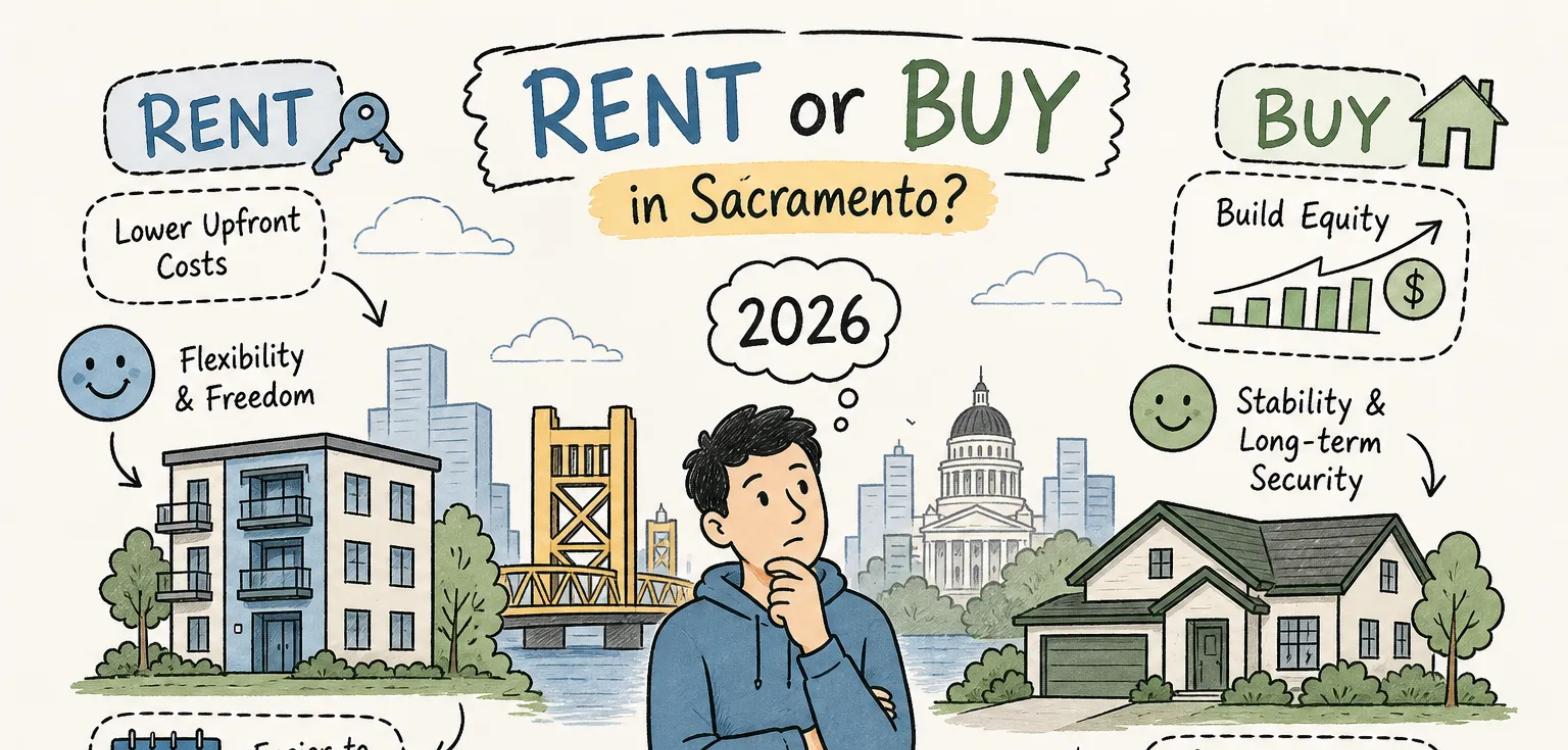
Sacramento renters are quietly running the same mental calculation right now: with rents sliding and home prices flat, does buying a home finally pencil out? If you are asking whether it is better to rent or buy a home in Sacramento right now, the 2026 market has shifted enough that the answer is no longer obvious. The median home price sits near $510,000 (Redfin, June 2026), while the median rent hovers around $1,950 per month (Realtor.com). Those two numbers look far apart until you start accounting for equity, tax benefits, and where rents are likely heading over the next five years.
This article skips the general advice and shows the actual monthly numbers side by side, using real Sacramento market data from mid-2026. Kyle Butterfield (NMLS #2717196), a Sacramento mortgage loan officer, runs this exact comparison for local renters every week, and the results are surprising more people than expected. The rent-versus-buy decision is a financial one, and the numbers tell a clearer story than most renters realize.
Rates, payments, and dollar amounts below are illustrative examples only, not a quote or commitment to lend, and are not guarantees of future appreciation or savings. Payments do not include taxes and insurance unless noted; your actual payment obligation will be higher. Contact Kyle Butterfield for your personalized rate, APR, and payment based on your credit profile and current market conditions. All loans subject to credit approval and program availability.
What Sacramento's Housing Market Actually Looks Like in 2026
The Sacramento housing market has cooled meaningfully compared to 2023 and 2024, and that shift matters for anyone weighing whether to rent or buy a home in Sacramento right now. Prices are softer, inventory is higher, and homes are sitting on the market longer. For buyers, that means more options, less competition, and more room to negotiate.
Redfin data from June 2026 puts the Sacramento median sale price at $509,723. Zillow separately reports a roughly 1.4% year-over-year decline. Active listings in Sacramento County jumped 12.46% year-over-year, and the average days on market rose more than 22% compared to the prior year, according to Realtor.com county-level data. Buyers who felt squeezed out in 2022 and 2023 are finding a very different environment right now.
Sacramento's median rent also fell, dropping nearly 6% year-over-year to land around $1,950 per month, according to Realtor.com rent data. That sounds like good news if you rent, but falling rents carry a signal worth noting: when rents ease and home prices soften at the same time, the monthly gap between owning and renting narrows. That is exactly where Sacramento sits heading into the second half of 2026.
Sacramento median rent and home price: quick facts for 2026
Median sale price: $509,723 (Redfin, June 2026). Median asking rent: approximately $1,950/month (Realtor.com). Year-over-year price change: approximately -1.4% (Zillow). Year-over-year rent change: approximately -6% (Realtor.com). Active listings: up 12.46% year-over-year (Realtor.com). These are the anchors for every calculation in this article.
The True Monthly Cost of Buying a Home in Sacramento
Most rent-versus-buy comparisons fail because they only show the mortgage payment. The advertised number looks manageable until you add the costs that come with owning a home. Here is an honest breakdown using a median-priced Sacramento home at $510,000 and an illustrative 30-year fixed rate of approximately 6.7%, in line with the August 2026 benchmark reported by Freddie Mac (6.66% as of August 27) and Bankrate (approximately 6.71% mid-August). Your actual rate and APR will depend on your credit profile and market conditions at the time you apply.
With 20% down ($102,000), the loan balance is $408,000. At 6.7% on a 30-year fixed, the monthly principal and interest payment comes to approximately $2,648. That is the figure most buyers see advertised. It is not the whole bill. Payments do not include taxes and insurance; your actual payment obligation will be higher.
Add the carrying costs specific to Sacramento ownership and the picture changes:
- Property tax (Sacramento County effective rate ranges from approximately 0.76% to 1.1%, inclusive of the Prop 13 base levy plus local assessments; this example uses the higher end of that range): approximately $390 to $467/month on a $510,000 home
- Homeowners insurance: approximately $110/month (based on California state average estimates for comparable homes)
- Maintenance reserve (1% of value annually, per standard lending guidance): $425/month
- HOA (if applicable): $0 to $400/month
The honest total monthly ownership cost lands between $3,575 and $3,650 at the lower tax assumption, or up to $4,050 using the higher rate, not counting HOA. That is higher than most buyers expect when they first start the conversation. The principal and interest portion, however, is locked at $2,648 for the life of a fixed-rate loan, it does not adjust with the market the way rents can over time. Property taxes, insurance, and HOA fees can still increase over time and should be factored into long-range planning.
Side-by-side: renting vs. owning in Sacramento
| Cost item | Renting | Owning ($510K home, 20% down) |
|---|---|---|
| Base housing payment | $1,950/mo | $2,648/mo (P&I) |
| Property tax | $0 | $390-$467/mo |
| Insurance | $0 (renter's ~$15) | $110/mo |
| Maintenance reserve | $0 | $425/mo |
| Total monthly outlay | ~$1,965 | ~$3,575-$3,650 |
The $1,600 to $1,685 monthly difference is real and deserves to be taken seriously. But this table leaves out three things that change the long-term math significantly: what happens to the renter's savings over time, how rent trends upward even when it temporarily dips, and the equity and tax advantages that offset the owner's higher monthly cost. Those three factors are where the decision actually gets made for most Sacramento residents.
The Math That Favors Buying: Equity, Appreciation, and Tax Savings
Ownership's financial advantage over renting does not come from the monthly payment. It comes from what happens to your money over a five-to-ten year window. Two forces can swing the long-term calculation toward buying for Sacramento residents who plan to stay at least five years, though neither is guaranteed and both depend on market conditions outside anyone's control.
On a $408,000 loan at 6.7%, a Sacramento owner pays down approximately $7,800 in principal during year one alone. Over five years, principal paydown accumulates to roughly $37,600, even if the home never appreciates a dollar. Home values can also decline; past performance and current projections are not a guarantee of future appreciation. As an illustrative scenario only, if Sacramento prices were to rise at a modest 2% to 3% annual pace from their current soft floor, appreciation could add approximately $53,000 to $82,000 in hypothetical value over five years. Combined with principal paydown, illustrative total equity gains could reach $90,000 to $120,000 depending on the scenario, but this is a projection, not a promise, and actual results will vary. A renter writing a $1,950 check each month builds no equity from that payment.
Homeowners who itemize may also be able to deduct mortgage interest, which can reduce taxable income in the early loan years when interest makes up the largest share of each payment. For a Sacramento buyer in the 22% or 24% federal tax bracket, this deduction could translate to roughly $4,000 to $6,000 in annual federal tax savings, based on first-year interest of approximately $27,000 on a $408,000 loan at 6.7%. This benefit applies only if you itemize deductions rather than take the standard deduction, and SALT limitations may affect the net savings depending on your situation. Consult a tax professional for guidance specific to your filing status; Dwell Mortgage, LLC and Kyle Butterfield do not provide tax advice.
Rent growth is the other variable the table does not show. Sacramento rents fell in 2025 and 2026, but analyst forecasts, including projections from CoStar tracking supply-demand normalization, point to a possible return toward 1% to 3% annual growth by 2027. A renter paying $1,950 today could plausibly pay $2,150 to $2,250 within three years under that scenario, though rent trends are not guaranteed and can move either direction. A homeowner's principal and interest payment does not move with a fixed-rate loan.
Programs That Bring the Buying Cost Closer to Rent Than You Might Expect
The 20% down assumption used in the comparison above is not what most Sacramento first-time buyers actually use. Several active programs in 2026 reduce the upfront cash requirement significantly, and some lower the ongoing monthly cost as well. These programs exist specifically for the income range many Sacramento renters fall into.
The most relevant options currently available to Sacramento buyers include:
- CalHFA MyHome: A deferred junior lien covering up to 3.5% of the purchase price for FHA buyers, reducing out-of-pocket down payment at closing. Current eligibility details and income limits are available through CalHFA program bulletins.
- CalHFA Dream For All: Up to 20% of the purchase price (maximum $150,000) for first-generation buyers through a shared-appreciation structure, with Sacramento County income limits set at $245,000 for 2026, per the 2026 Dream For All program notice.
- SHRA CalHome and PLHA programs: City and County of Sacramento deferred-payment assistance for income-qualifying first-time buyers purchasing within city or county limits.
- GSFA Platinum: Up to 5% assistance on FHA, VA, or conventional loans with no first-time buyer requirement.
- Mortgage Credit Certificate (MCC): A federal tax credit on a portion of mortgage interest paid annually, available through SHRA. Not cash at closing, but ongoing annual tax savings that reduce effective ownership cost.
A Sacramento buyer using CalHFA MyHome with 3.5% down on a $400,000 home could reduce the required cash at closing from roughly $80,000 (20% down) to approximately $14,000, as an illustrative example. Because MyHome is a deferred junior lien, the loan balance is higher, PMI may apply, and closing costs remain separate, so the actual cash needed at closing will vary based on lender requirements and eligibility. Still, the upfront barrier shrinks meaningfully for many buyers. Results vary based on household income, credit profile, and program availability at the time of application.
Is It Better to Rent or Buy a Home in Sacramento Right Now? A Quick Checklist
The rent-versus-buy question is not the same for every Sacramento renter. It depends on income, credit score, savings, planned length of stay, and which programs you qualify for. Before running detailed numbers, this checklist gives you a fast read on where you likely stand.
Buying tends to make more financial sense if you plan to stay five or more years, your household income is stable, your credit score is 640 or above, and you have access to down payment assistance that reduces the upfront barrier. Renting continues to make sense if you expect a major life change within two years, your income or employment is in transition, or your savings position does not yet support the full carrying costs shown above.
Reading market data is useful, but running your actual numbers is what turns this from a general question into a specific answer.
How a Free 30-Minute Conversation Can Answer This for Your Specific Numbers
Kyle Butterfield (NMLS #2717196) offers free pre-approval consultations that use a soft credit inquiry so your score is not affected. In a single 30-minute conversation, you walk away knowing your qualifying purchase price at today's rates, your actual monthly payment broken down line by line, which down payment assistance programs apply to your situation, and how your total monthly ownership cost compares to your current rent. No credit pull impact, no sales pressure. Just your numbers on paper so you can make an informed decision on your own timeline.
The most common thing Sacramento renters discover is that the barrier is not their income, it is not knowing their actual numbers. Reach out to Kyle directly to schedule your free consultation and get your own Sacramento rent-versus-buy comparison.
The Bottom Line for Sacramento Renters in 2026
Whether renting or buying makes more sense in Sacramento right now depends on your specific numbers, not on a general rule. What the 2026 market does offer is a window that has not been this open in several years: prices are soft, inventory is up, rates have stabilized in the mid-6% range, and first-time buyer programs are actively reducing the cash barrier for buyers across a broad range of income levels.
The monthly cost of owning is higher on paper. That part of the table is accurate. But once equity buildup, the mortgage interest deduction, and the long-term trajectory of rent inflation enter the picture, the gap can narrow considerably for buyers who plan to stay five or more years, though individual outcomes depend on market conditions and are never guaranteed. The decision becomes clearer when you replace general comparisons with your actual income, your actual credit profile, and the programs available to your specific situation.
Schedule a free, no-pressure pre-approval conversation with Kyle Butterfield (NMLS #2717196) to get your personalized comparison and find out exactly where you stand.