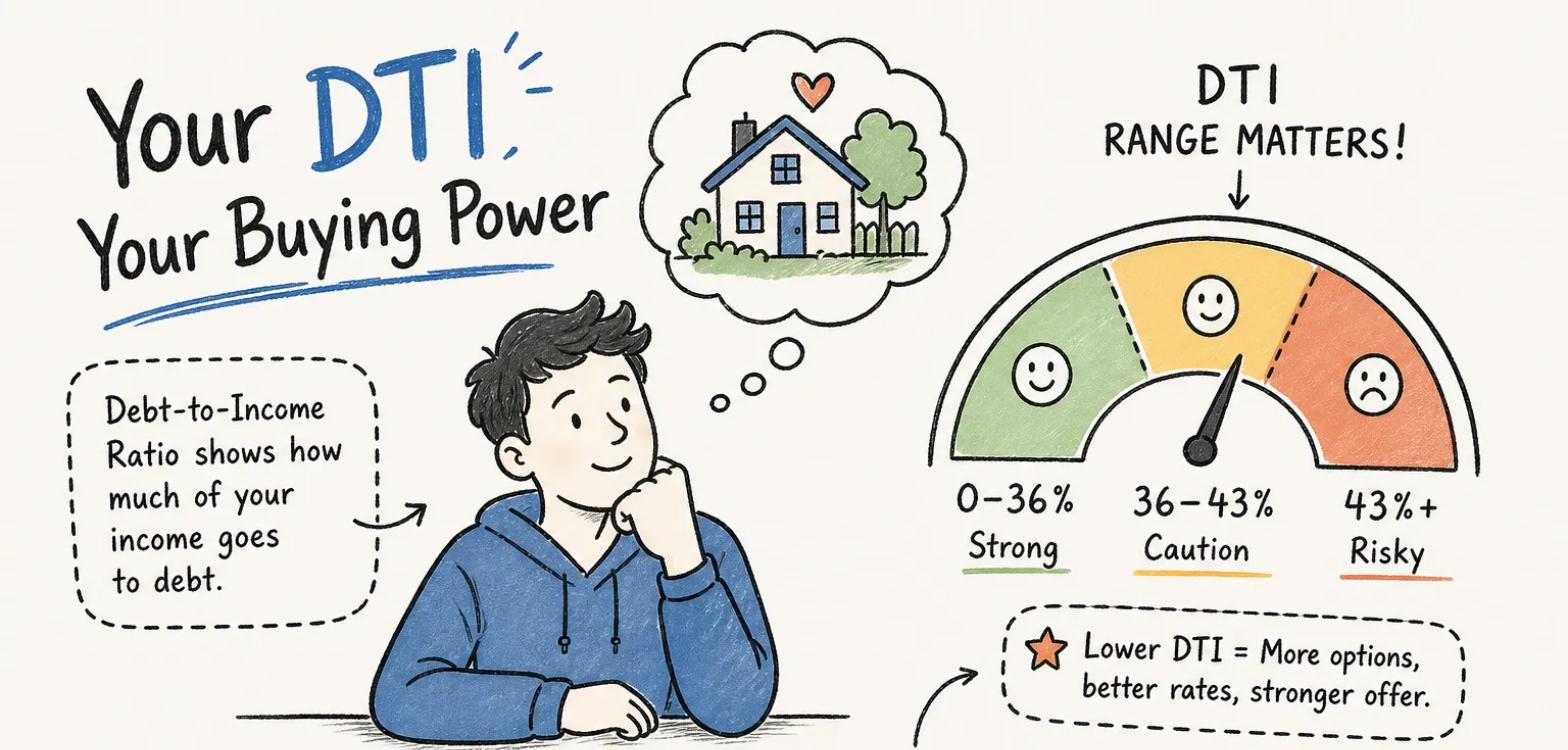
What does debt-to-income ratio mean when buying a home? Picture a Sacramento renter earning $120,000 a year. Good income, stable job, solid credit score. They assume a mortgage approval is basically a formality. Then they sit down with a lender and discover that two car payments, student loans, and a couple of credit cards have quietly built a wall between them and homeownership. The income looked fine. The debt load did not.
That wall has a name: your debt-to-income ratio, or DTI. It's the actual calculation lenders run to determine whether you can handle a mortgage payment on top of everything else you already owe each month. Many buyers never think to calculate it before they apply, which is exactly why so many walk into pre-approval conversations unprepared.
This guide will walk you through how DTI works, how to calculate both versions lenders check, what each loan type allows, and the specific moves that lower your ratio before you apply.
Figures below are illustrative examples only. Your actual qualifying ratios, payment, and program eligibility depend on your credit profile, documentation, and underwriting guidelines in effect at the time you apply. Contact Kyle Butterfield for your personalized numbers. All loans subject to credit approval.
What the Debt-to-Income Ratio Actually Is, and Why Lenders Live By It
DTI is the percentage of your gross monthly income (before taxes, not take-home pay) that goes toward required monthly debt payments. The word "required" matters here. Lenders count minimum monthly obligations, not whatever extra you choose to pay above that minimum. A $15,000 credit card balance counts only as its minimum monthly payment in the formula, not the full balance.
Lenders use this ratio because income alone doesn't tell the full story. A $120,000 salary sounds strong until you account for $2,000 in existing monthly debt obligations. Add a $2,200 mortgage payment and suddenly that borrower is committing a significant share of every dollar they earn before taxes to debt service. DTI captures that reality in a single percentage.
The formula is simpler than it looks
Divide your total monthly debt payments by your gross monthly income, then multiply by 100. If your monthly debt obligations total $4,000 and your gross monthly income is $10,000, your DTI is 40%. That's the entire calculation. No complicated weighting, no special variables. Many buyers find it helpful to use a DTI calculator to run these numbers quickly before meeting with a lender.
Why DTI can outweigh your credit score
A strong credit score tells lenders you've managed past debt responsibly. DTI tells them whether you can absorb new debt right now. Automated underwriting systems at most major lenders, including Fannie Mae's Desktop Underwriter and Freddie Mac's Loan Product Advisor, run a DTI check as a primary capacity test, and a high ratio can stall an approval even when the credit score is excellent. Both numbers matter, but DTI is the one that trips up the most buyers who never thought to check it first.
What Does Debt-to-Income Ratio Mean When Buying a Home?
At its core, understanding what debt-to-income ratio means when buying a home comes down to this: lenders want to know that your monthly income is large enough to cover your new housing costs and all your existing obligations with room to spare. Your mortgage qualification ratio, the DTI threshold a given loan program requires, determines whether your file moves forward or stalls. Every loan program has its own standard, and knowing yours before you apply is the difference between a confident offer and a last-minute scramble.
Front-end vs. back-end DTI: the two numbers lenders actually check
Lenders don't run one DTI calculation; they run two. Most first-time buyers don't know this until they're sitting across from an underwriter. Both figures use the same formula, but they include different debts in the numerator.
Front-end DTI (your housing ratio). Front-end DTI measures only the proposed housing payment divided by gross monthly income. That housing payment includes principal, interest, property taxes, homeowner's insurance, any HOA dues, and mortgage insurance if applicable. This is often called the housing ratio. Per published guidelines from Fannie Mae, Freddie Mac, and FHA program materials, lenders generally look for front-end DTI to stay under 28% to 31%, depending on the loan program, though automated underwriting can flex on this number when other factors are strong.
Back-end DTI (your total debt picture). Back-end DTI takes the full picture: proposed housing payment plus every other recurring monthly debt obligation, divided by gross monthly income. This is the number underwriters focus on most, because it captures the borrower's complete financial commitment each month. When a lender says a buyer's DTI is too high, they're almost always talking about back-end DTI.
Walking through a real Sacramento example
Take that $120,000 annual salary: $10,000 in gross monthly income. As an illustrative example: a proposed mortgage (PITI) of $1,850 per month, a $480 car payment, $220 in student loan payments, and $75 in minimum credit card payments. Front-end DTI is $1,850 divided by $10,000, which equals 18.5%. Back-end DTI is $2,625 divided by $10,000, which equals 26.25%. That's a clean file.
Now add a second car payment of $450. Back-end DTI jumps to 30.75%. Add a personal loan and it climbs further, the income is identical, but the picture looks meaningfully different.
Which Monthly Payments Count Toward Your DTI Calculation
Buyers are often surprised by this list in both directions. Some debts they worried about don't count at all. Others they forgot about absolutely do.
Debts that lenders include
The standard inclusions are minimum credit card payments, auto loan payments, student loan payments, personal loan payments, alimony, and child support. For student loans on income-driven repayment plans, conventional loans backed by Fannie Mae generally use the actual documented payment, including $0 if that's what's reported. FHA loans typically require at least 0.5% of the outstanding balance if the documented payment is $0. Freddie Mac and some individual lenders may use alternate balance-based methods when a $0 payment is documented, so the treatment can vary. The rule across all programs is that lenders count required minimums, not what you actually pay.
Expenses that don't count
Utilities, groceries, subscriptions, cell phone bills, gas, and health insurance premiums are not included in DTI. This genuinely surprises buyers who assumed their full monthly budget would be scrutinized. DTI is specifically a debt ratio, not a cost-of-living snapshot. Your monthly grocery bill is invisible to the formula.
How a co-borrower changes the calculation
Adding a co-borrower combines both incomes and both debt obligations into a single DTI calculation. A co-borrower with strong income and minimal monthly debts can meaningfully lower a joint DTI. A co-borrower with significant existing obligations (multiple car payments, large student loans) can push it higher, even with good income. The math runs in both directions, so it's worth calculating the joint DTI before deciding whether to apply together or separately.
DTI Limits by Loan Type: What Different Programs Actually Allow
Each loan program has its own threshold, and the flexibility available depends on compensating factors like credit score, down payment size, and cash reserves.
Conventional loans
Per conventional underwriting guidance from Fannie Mae and Freddie Mac, back-end DTI in the 36% to 45% range covers most standard approvals, though lender overlays can vary. Stronger files, higher credit scores, significant reserves, larger down payments, can be approved up to 50% through automated underwriting systems like Fannie Mae's Desktop Underwriter. The cleaner the overall file, the more flexibility the system grants on DTI.
FHA and government-backed loan thresholds
Per the FHA Single Family Housing Policy Handbook, FHA guidelines use 31% front-end and 43% back-end as standard benchmarks. With specific compensating factors, manually underwritten FHA loans can be approved up to 50% back-end DTI, and automated approvals in particularly strong files have, in some documented cases, reached higher, though those outcomes depend on a narrow set of conditions and should not be treated as typical. USDA loans typically hold to 29% front-end and 41% back-end. FHA is frequently the right path for Sacramento buyers with moderate credit or limited down payment savings, precisely because of this flexibility.
VA loans and why they work differently
VA loans don't operate on a strict DTI cap the way other programs do. The VA uses a residual income standard, what's left over after all debts and housing costs are paid, as the primary measure of a borrower's ability to cover living expenses. A 41% DTI guideline exists, but files can be approved well above that threshold when residual income is strong. This makes VA loans uniquely flexible for eligible veterans and active military in the Sacramento region, and it's one of the most underappreciated benefits of the program.
How to Lower Your DTI Before You Apply for a Mortgage
Once you know where your DTI stands, the next question is what to do about it. For mortgage qualification, reducing your monthly payment obligation matters more than reducing total balances. A buyer who pays off a $7,000 car loan with a $480 monthly payment improves their DTI immediately. Paying down a $15,000 credit card balance by $5,000 might barely move the minimum payment, which means it barely moves the DTI. Strategy matters here.
Prioritize installment debts with meaningful monthly payments
Eliminating an installment loan (car loan, personal loan) removes the entire monthly obligation from the DTI equation in one move. If a loan has only a few payments remaining or can be paid off with accessible savings, it's often the highest-leverage action available before applying. The full monthly payment disappears from the calculation the moment the loan is closed out.
Reduce revolving balances to shrink minimum payments
Paying down credit card balances reduces the minimum payment lenders count toward DTI. This also improves credit utilization, which can lift your credit score heading into pre-approval. It's a two-for-one improvement: the DTI drops, and the credit profile strengthens at the same time. Focus on cards where a meaningful reduction in balance will actually move the minimum payment.
Avoid new debt and document every income source
New financing of any kind, a furniture plan, a new vehicle, a personal loan, adds to monthly obligations and complicates underwriting. Hold off on any new credit until after closing. On the income side, make sure every legitimate income source is properly documented: overtime, recurring bonuses, verifiable side income, and rental income may all qualify for inclusion in gross monthly income. More documented income lowers DTI from the other direction without paying off a single debt.
Running Your Actual Numbers Before You Apply
Understanding DTI conceptually is step one. Calculating it accurately against your real financial picture, with a real loan scenario, is the step that actually prepares you to apply with confidence. Buyers who estimate their DTI informally often miss a debt, miscount a minimum payment, or forget that the full PITI will be meaningfully higher than the base mortgage payment alone. Getting the number wrong at the start leads to wasted time, unexpected credit inquiries, and unnecessary discouragement. In practice, running a precise calculation often takes a short meeting, typically 10 to 30 minutes depending on your documentation, with the right person walking you through it.
Kyle Butterfield (NMLS #2717196) offers free, no-pressure consultations specifically built around this kind of clarity. That means running your actual front-end and back-end DTI using real income documentation and a real loan estimate, not a ballpark figure. You leave the conversation knowing exactly where you stand and, if the number needs work, exactly which moves will improve it most efficiently. No sales pressure, no obligation.
The Bottom Line on Debt-to-Income Ratio
Understanding what debt-to-income ratio means when buying a home comes down to this: lenders measure required monthly debt payments as a percentage of gross monthly income, focus most on back-end DTI, and apply different thresholds depending on the loan program. Reducing monthly payment obligations, not just balances, is the most efficient way to move the number.
Conventional loans can stretch to 50% with strong compensating factors. FHA allows more flexibility than most buyers realize. VA loans for eligible veterans and military don't operate on a hard cap at all. The right loan program makes a significant difference, and that determination starts with knowing your actual DTI before anyone pulls your credit.
If you want to run your real numbers with no pressure and no guesswork, reach out to Kyle Butterfield (NMLS #2717196) for a no-obligation consultation. We'll calculate your front-end and back-end DTI together, look at which loan programs fit your situation, and figure out exactly what, if anything, needs to happen before you apply.